Building Resilient Communities

by Barbara Lach


cropped 2

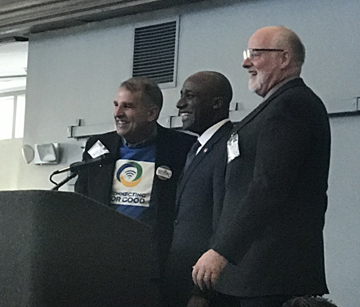
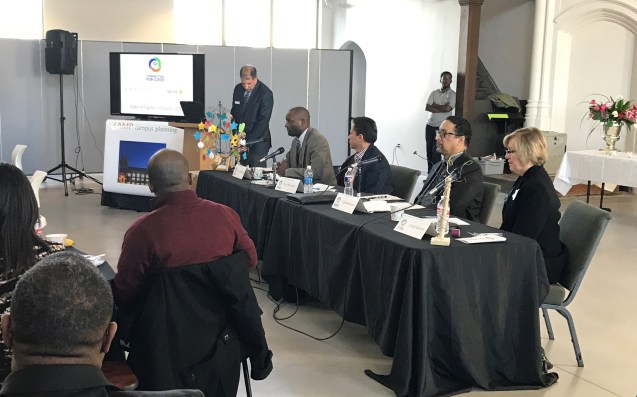
From left: Tom Esselman, CEO of Connecting for Good, Mayor Quinton Lucas, and Mayor/CEO David Alvey

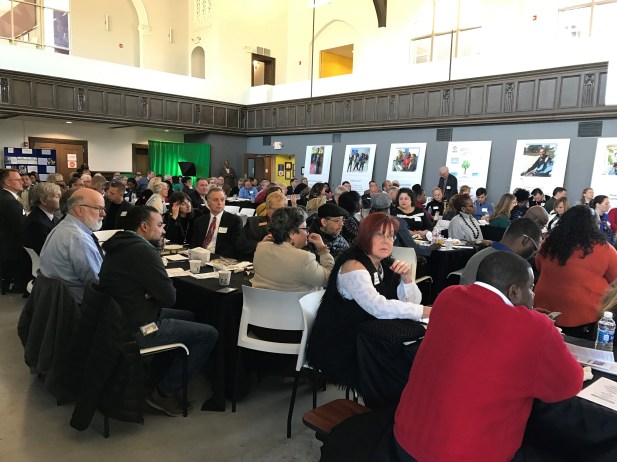
Kansas City, Kan., Mayor/CEO David Alvey and Kansas City, Mo., Mayor Quinton Lucas joined area digital inclusion leaders and activists at the 4th Annual Digital Inclusion event Dec. 4 hosted by Connecting for Good at its campus on Michigan Avenue in Kansas City.

Both mayors emphasized not only the significance of access to online resources as one of the factors in building resilient communities but also digital training and skill development.

“Creating opportunity is important,” Mayor Lucas said. “Digital literacy is providing the how, not just the who and the what.”

Mayor Alvey said Internet has become a fundamental part of infrastructure because all factors contributing to social determinants of health are linked directly to digital inclusion.

“On behalf of people Kansas City, Kansas, thank you to Connecting for Good for your efforts to connect persons and communities through digital equity,” Mayor Alvey said. “All of your work to provide Internet access, affordable computers, online educational content, technical support, computer skills training is already showing a positive effect for individuals, for families, for neighborhoods and for communities.”


The digital economy has transformed the way we work and communicate, making digital skills one of the most fundamental prerequisites for employment, but many residents miss on job opportunities because they lack the necessary training and Internet access, said Tom Esselman, CEO of Connecting for Good.

“Less than 46 percent of households have Internet access at home in this zip code,” Esselman said.

Esselman said his organization offers training and educational resources for the most vulnerable residents to develop the skills they need to enter the workforce, secure better jobs, strengthen family stability and build resilient communities. The Kansas City non-profit is a regional leader in bridging digital divides and one of only few organizations nationwide offering all five components of digital inclusion: Internet access, affordable computers, computer skills training, educational online content and technical support.

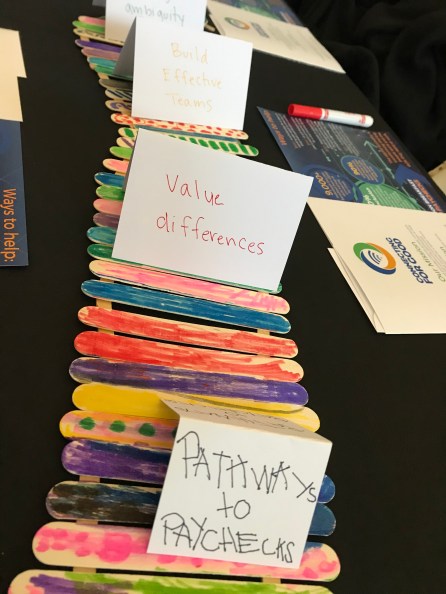
Third annual state of digital inclusion event: Digital skills pathways to paychecks

by Barbara Lach

IMG_3244

The digital economy has transformed the way we work and communicate, making digital skills one of the most fundamental prerequisites for employment, but many residents miss on job opportunities because they lack the necessary skills, said Tom Esselman, CEO of Connecting for Good, at the Third Annual State of Digital Inclusion event Dec. 5 hosted by Connecting for Good in Kansas City. Ninety percent of professionals must have at least basic digital skills training to perform their jobs.

Esselman said in partnership with community organizations and individual donors, Connecting for Good has provided digital skills training to almost 10,000 residents in 2018.

The Kansas City non-profit is a regional leader in bridging digital divides and one of only few organizations nationwide offering all five components of digital inclusion: Internet access, affordable computers, computer skills training, educational online content and technical support.

IMG_3260


Digital revolution not for all Americans

by Barbara Lach

cover

A picture is worth a thousand words…envision a white workforce with less than 2 percent African American representation.  Google, Facebook and Twitter employ 41,000 people; 1.8 percent of them are black.

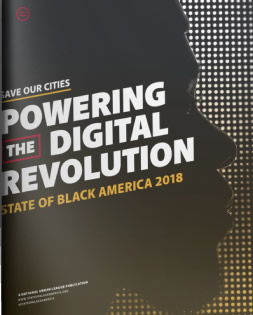
Owning mobile devices does not get African Americans jobs in social media and tech companies any more than it provides adequate technology to do homework even at elementary level.  African Americans enjoy less than 75 percent of the benefits of the digital economy when compared to white Americans today. The National Urban League highlights this technology gap in its 2018 State of Black America report released May 3.

The League has created a Digital Inclusion Index to demonstrate how often African Americans get a fair opportunity at upward mobility within the tech sector. The index measures three areas: digital skills and occupations, digital access, and digital policy. African Americans are at 74.1 percent.

In some areas African American score above average digital equity. Although 2.8 percent of African Americans and 2.6 percent of white youth earned degrees in computer and data science in 2015-16, racial diversity in social media and technology companies remains minimal—fewer than 5 percent of the workforce.

“Historically, while great industrial breakthroughs have profited our nation, African Americans have often been exploited, rather than elevated by these advancements,” said Marc H. Morial,  National Urban League President and CEO.


Dividing Lines: Why Is Internet Access Still Considered a Luxury in America?

trail

“Access to the internet is essential to modern American life,” Maria Smith explained in her March 27 talk at the Berkman Klein Center for Internet and Society at Harvard University. Job applications, school enrollments, efficient communication with doctors—all of these tasks now require reliable internet access. However, one in four Americans lives without a broadband connection in their home.

The online world is no longer a distinct world. It is an extension of our social, economic, and political lives. Internet access, however, is still often considered a luxury good in the United States. Millions of Americans have been priced out of, or entirely excluded from, the reach of modern internet networks. Maria Smith, an affiliate of Berkman Klein and the Cyberlaw Clinic, created a four-part documentary series to highlight these stark divides in connectivity, from Appalachia to San Francisco, and to uncover the complex web of political and economic forces behind them.

The fight for net neutrality is just beginning

by Barbara Lach


Net without neutrality is like a highway with only a few on-ramps for those who can pay the most.

Let’s imagine for a second that we privatize access to the entire U.S. interstate system with more than 46,000 miles of highways and replace every on-ramp with a tollbooth. No access to the highway unless you pay. Now let’s have each tollbooth owner decide the monetary value of access. The owner may decide such access depends on speed limits on the highway, types of vehicles entering, contents of such vehicles or even zip codes. Sounds odd? You bet!

This is how the Federal Communications Commission understands Internet access in today’s America. Reversing the agency’s 2015 decision of stronger oversight over broadband providers, the FCC repealed its net neutrality rules on Dec. 14, 2017. These protections prohibited broadband providers from blocking websites and charging selectively for certain content. The federal government will also no longer regulate the delivery of high-speed Internet as a utility, much like a phone service. Broadband providers are empowered to control who can access the online world–and when and how they do so.

The FCC order repealing net neutrality was published Feb. 23 in the Federal Register, clearing way for Congress to reverse net neutrality with a vote. Since December, legislation to enforce net neutrality has been introduced in more than one half of US states. Free Press filed one of the first lawsuits to overturn the FCC’s net neutrality-gutting vote, and more than 20 state attorneys general are also suing the FCC. Millions of Americans have voiced opposition to the FCC’s ruling and in support of protections for all to connect and communicate.

On Feb. 27 you can join users, businesses, communities and popular websites in an effort to mobilize lawmakers to pass a resolution of disapproval that would overturn the FCC’s net neutrality repeal: Operation #OneMoreVote www.freepress.net.


Missouri legislators determined to ban community broadband networks

by Barbara Lach


TelecommSeal_of_Missouri.svgunications incumbents in Missouri found this year a legislative ally in Sen. Ed Emery and together are well on their way to kill municipal networks…yet again.

Introduced in January by Sen. Emery, Senate Bill 186 cleared its way to the full Senate for debate. Using blanket restrictions that prevent cities from selling any type of goods or services—including broadband—when private businesses already offer such goods and services, the bill prohibits municipalities from providing broadband utility services. SB 186 comes less than a year after previous legislative assault on municipal networks in Missouri, HB 2078, failed thanks to arduous work of many community broadband supporters.

To make sure that community networks are never deployed in Missouri, SB 186 also allows incumbent telecoms to define the term ‘broadband.’ Incumbents could define and offer broadband as 10 Mbps download and 1 Mbps upload, although the FCC defines broadband as 25 Mbps down and 3 Mbps up. This in itself will prevent a city from starting its own network. In addition, this bill prohibits municipalities from forming partnerships with private sector companies to deploy broadband. As a result of this legislative action, Missouri residents will be stuck with lower speeds, inferior services and higher prices—bad for the people, bad for the economy, bad for education and bad for America.

The plea of some technology companies and policy organizations, such as Google, Netflix and Next Century Cities, to reject SB 186 as “a virtual ban on local choice, harming both the public and private sectors, stifling economic growth,” job creation and quality of life, has fallen on deaf ears of Sen. Dan Hegeman, Vice-Chairman of the Economic Development and Local Government Committee. Their argument in favor of businesses’ timely access to advanced networks and customers’ access to modern products and services went ignored by Missouri legislators. In their letter to Sen. Hegeman, the tech companies and advocates wrote SB 186 “is bad for Missouri communities…bad for private sector, particularly high-technology companies, and bad for America’s global competitiveness.” In pushing SB 186 to a Senate vote, Missouri legislators demonstrate strong support for monopolies while stifling residents’ access to fast Internet and all the advantages that it offers.

Municipal broadband networks serve well in communities where incumbent private service providers contribute to the digital divide or fail to upgrade infrastructure for high-speed Internet. Case in point Chattanooga, Tenn. The “Gig City” runs taxpayer-owned fiber optic network that provides affordable and very fast connections to its residents. But successful community-owned networks, like the Gig City or Greenlight in Wilson, NC, or the Roanoke Valley Authority, Va., are under attack. Backed by incumbents, such as AT&T, Verizon and Charter, anti-municipal broadband legislation intends not only to keep the existing city-owned networks from expanding but also to ban deployment of new networks. For example, Virginia House Bill 2108, introduced by state Delegate Kathy Byron, who received contributions from six telecom corporations, to limit municipal initiatives is now before the state senate. In Tennessee some legislators with good intentions, like Rep. Dan Howell, have argued since 2016 to repeal a law that limits community broadband, but incumbent AT&T of Tenn., which received $156 million in federal subsidies in September, lobbied successfully to delay HB 1303 for a year, thus preserving big telecoms’ monopoly. Christopher Mitchell of the Institute for Local Self Reliance urges to advocate for community broadband. Mitchell said, “Missouri should be encouraging investment and local Internet choice, not working with monopoly lobbyists to prevent it.”

Missouri legislators should not go out of their way to stifle competition and limit broadband access to the underserved residents, schools and municipalities. Under the old-fashioned concept of government, government actually governs to benefit the people. In 2017, however, our state government has abandoned large portions of city and rural residents, leaving them at the mercy of multi-billion dollar telecom corporations. Community-owned and municipal networks have an uphill battle against incumbents; they do not need the state government to prohibit them from even beginning the trek up the hill. What state legislators should do, instead, is work feverishly to remove the barriers to entry for local governments that are interested in connecting people left behind by the cable behemoths.

Tri logo small

First annual state of digital inclusion: digital education for all ages

by Barbara Lach

Digital inclusion is ageless but digital education should begin as early as kindergarten, agreed panelists at the first annual State of Digital Inclusion event hosted Dec. 8 by Connecting for Good in Kansas City. The Kansas City non-profit is a regional leader in bridging the digital divide.

img_0631-cropped


From left: Tom Esselman (standing), Mark Bedell, Chris Hernandez, Clyde McQueen, and Carole Malotte


The panel focused on a causal relationship between digital education and careers and quality of life. As an element of rudimentary education, developing digital skills should be part of K-12 curriculum, said Clyde McQueen, executive director of KC Full Employment Council. To prepare young people for careers today, digital education must start early, McQueen said as he mentioned the Kauffman Foundation’s, one of the event’s sponsors, recent announcement of an $80 million investment in postsecondary education over 10 years. Superintendent Mark Bedell, Kansas City Public Schools, also emphasized the importance of developing digital literacy and skills in K-12 as a path to successful careers and citizenship.

Another age-related aspect of digital education was raised by Carole Malotte, director of AARP Foundation SCSEP. As newcomers to digital technology, the elderly represent a substantive population group that can, and should, benefit from digital training to be able to use online services. “Success is defined by quality of life, not only by a great job,” Malotte said. Knowing how to use a computer and navigate the Internet improves the quality of life for older people.

As a community, Kansas City is facing a digital equity problem. Chris Hernandez, communications director for Kansas City, MO, said the Smart City initiative, a $15 million private-public partnership, provides funding for a free-to-riders streetcar, which connects business, arts and shopping districts, and offers free Wi-Fi coverage along the line. Despite such an initiative, digital equity of access to the Internet and skill sets across the City remains a challenge.

“As a community, we must get connected better,” McQueen said.

Tom Esselman, CEO of Connecting for Good, said his organization is building a digital inclusion ecosystem across Kansas City, in which both technology and education come together to bridge the social and economic gaps. In addition to low or no-cost broadband services and refurbished computers, Connecting for Good provides free digital training to low-income and unemployed residents of all ages.

img_0630

Tri logo

The Matthew effect of digital dividends, or how open data deepens digital divide and weakens democracy

by Barbara Lach

Open data is just one of many digital dividends of new technologies, albeit an important one for modern participatory democracy. Other dividends include instant access to information, news, financial services, education, jobs, health services, social media and civic and political engagement. All these digital dividends have one thing in common—these benefits depend on broadband Internet access. Consequently, citizens who do not have Internet access, or 55 million Americans, can enjoy none of these benefits. For 17 percent of the population, open data remains closed, and with it the chance for civic engagement.

new dividends

Driven by calls for greater government transparency, opening up of public information is a noble cause in itself. But citizens can take advantage of open data only if they can access and apply the data. Data for data’s sake is meaningless; only data that can be applied is meaningful. Data application, though, requires Internet access and knowledge. Because only those with an uninhibited access to technologies and education can apply data, they are the ones who learn and profit from open data first. When information becomes available, the rich profit the most, and the poor become not only poorer but also disengaged. This is the Matthew effect, or accumulated advantage, of open data.

Today 40 states and 48 localities provide data sets to the federal online open data repository. Open data, not to be confused with big data, means that public information is accessible online to the public—it becomes a public resource. The Open, Public, Electronic and Necessary (OPEN) Government Data Act that went into effect May 25 of this year requires the government to provide all public federal information in searchable open formats freely available to anyone online. Making public information accessible online allows citizens to understand how the government spends money, for example, and thus hold public elected officials accountable. Open data of procurement processes at all government levels could shed light on how the government buys goods and services from the private sector. On a local level, open data can benefit citizens through improved city services.

Participation in governance and the process of democratization that surround the movement to open data are subject to Internet access. Improved quality of life and government services remain just a promise for all those who cannot afford an Internet connection. For example, four in five households in inner Kansas City have no home Internet access, so application of open data is not even an issue for them. They simply have no data. They are excluded from the culture of shared public information.

Universal Internet access would expand opportunities and enable civic and political engagement for all. The Matthew effect means that those without access are not only denied the advantage of having information at their fingertips but also that they continue to fall further behind in terms of civic engagement. They are excluded from the participatory political process and the tech-driven government transparency–both predicated on Internet access—which makes the concept of informed and participatory citizenry elitist. Only the elite–the privileged and technologically savvy–enjoy open data dividends. The Matthew effect of digital dividends leaves almost 50 million Americans without a civic voice.

Tri logo

Documentary shows what digital divide means


doc


by Maria Smith

Director and Producer, 2015

A stark 30 percent of Americans do not have wired Internet access. In our information-driven world, this digital divide raises important questions of social inequality and national economic stagnation. One Nation, Disconnected is a short documentary that wrestles with these issues. It is the story of a young woman who faces the daily challenges of today’s digital divide.


Berkman Center for Internet and Society

Harvard Law Documentary Studio