by Barbara Lach
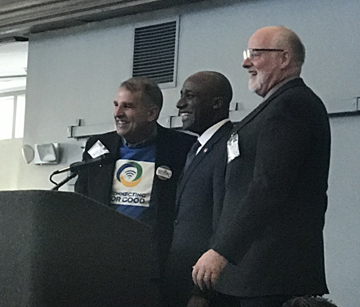
From left: Tom Esselman, CEO of Connecting for Good, Mayor Quinton Lucas, and Mayor/CEO David Alvey
Kansas City, Kan., Mayor/CEO David Alvey and Kansas City, Mo., Mayor Quinton Lucas joined area digital inclusion leaders and activists at the 4th Annual Digital Inclusion event Dec. 4 hosted by Connecting for Good at its campus on Michigan Avenue in Kansas City.
Both mayors emphasized not only the significance of access to online resources as one of the factors in building resilient communities but also digital training and skill development.
“Creating opportunity is important,” Mayor Lucas said. “Digital literacy is providing the how, not just the who and the what.”
Mayor Alvey said Internet has become a fundamental part of infrastructure because all factors contributing to social determinants of health are linked directly to digital inclusion.
“On behalf of people Kansas City, Kansas, thank you to Connecting for Good for your efforts to connect persons and communities through digital equity,” Mayor Alvey said. “All of your work to provide Internet access, affordable computers, online educational content, technical support, computer skills training is already showing a positive effect for individuals, for families, for neighborhoods and for communities.”
The digital economy has transformed the way we work and communicate, making digital skills one of the most fundamental prerequisites for employment, but many residents miss on job opportunities because they lack the necessary training and Internet access, said Tom Esselman, CEO of Connecting for Good.
“Less than 46 percent of households have Internet access at home in this zip code,” Esselman said.
Esselman said his organization offers training and educational resources for the most vulnerable residents to develop the skills they need to enter the workforce, secure better jobs, strengthen family stability and build resilient communities. The Kansas City non-profit is a regional leader in bridging digital divides and one of only few organizations nationwide offering all five components of digital inclusion: Internet access, affordable computers, computer skills training, educational online content and technical support.
 Decoding digital divides