by Barbara Lach
That poverty affects society in negative ways is a cliché. Even those who never set foot, or even drive through, poverty-stricken neighborhoods know that such communities are low in income, jobs, education, health, safety and connectivity. These days we can avoid conveniently such communities altogether by using apps like “Ghetto Tracker,” renamed “Good Part of Town” after immediate backlash. Convenience and avoidance sometimes enable us to ignore the obvious—poverty in America is at the 2008 recession record level.
A novel development, however, makes our ‘traditional’ notion of poverty outdated at best. Today poverty in America is more concentrated in distressed areas than it was a decade ago, The Brookings Institute reports, for example in areas like the one east of Troost in Kansas City or the South Side in Chicago. More than twice as many Americans lived in extremely poor neighborhoods in 2010-2014 than in 2000. The effects of this recent concentration, given our increasingly digitized world, mount exclusion on top of poverty. It is easy to leave people in “the dark” if they are concentrated together. It is easy to leave people on the other side of the digital divide.
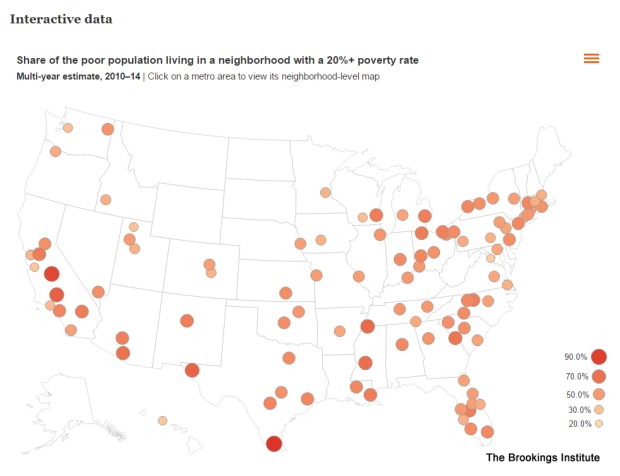 Concentrated poverty means not just lack of economic and social opportunities. It means lack of access to quality education, jobs, healthcare, daycare, citizenship, legal services, the political process and technological advances. It means disconnection from many resources and disengagement from active citizenship. Conversely, studies have shown that children who move to lower-poverty communities are more likely to attend college and have substantially higher incomes as adults.
The ubiquitous Internet could become the much needed uplifting tool for those in concentrated poverty areas; enabling Internet access could help to bridge the digital dive. While not a panacea to all socioeconomic challenges, Internet access does open opportunities—to communicate, gain knowledge, apply for jobs, shop, access healthcare resources and online financial services, just to name a few. Unfortunately, lack of Internet access offers none of these opportunities. Instead, to make things even worse, all the apps and online resources, which are so readily available today, build invisible fences that hold captive many Americans in disadvantaged communities. This persistent digital divide exacerbates poverty.
So why do we care? We should care because all residents, at or below the federal poverty level (e.g., $24,300 for a family of four in 2016), in these communities face socioeconomic challenges, from poor-performing schools to high crime rates, and the chances for economic mobility for those below or at the poverty level diminish every year. They are entrenched. We should care because concentrated poverty results in negative consequences for all of us, regardless of how many apps we carry on our cell or how tucked away we are in our suburbia (albeit the suburbs’ home is the largest and fastest-growing poor population).
The digital divide impoverishes the poorest and leaves all of us behind many other developed nations on the digital highway. As other countries, like South Korea and Sweden, speed in the digital era, our very own domestic lack of Internet access only exacerbates socioeconomic inequality. Internet access as a utility could be the leverage we need to enable all Americans partake in the digital revolution and the global digital community. Internet access for all benefits all.

 Decoding digital divides