The Matthew effect of digital dividends, or how open data deepens digital divide and weakens democracy

by Barbara Lach

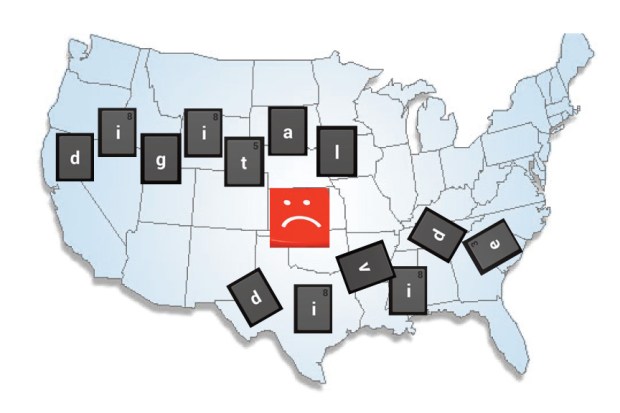
Open data is just one of many digital dividends of new technologies, albeit an important one for modern participatory democracy. Other dividends include instant access to information, news, financial services, education, jobs, health services, social media and civic and political engagement. All these digital dividends have one thing in common—these benefits depend on broadband Internet access. Consequently, citizens who do not have Internet access, or 55 million Americans, can enjoy none of these benefits. For 17 percent of the population, open data remains closed, and with it the chance for civic engagement.
new dividends

Driven by calls for greater government transparency, opening up of public information is a noble cause in itself. But citizens can take advantage of open data only if they can access and apply the data. Data for data’s sake is meaningless; only data that can be applied is meaningful. Data application, though, requires Internet access and knowledge. Because only those with an uninhibited access to technologies and education can apply data, they are the ones who learn and profit from open data first. When information becomes available, the rich profit the most, and the poor become not only poorer but also disengaged. This is the Matthew effect, or accumulated advantage, of open data.

Today 40 states and 48 localities provide data sets to the federal online open data repository. Open data, not to be confused with big data, means that public information is accessible online to the public—it becomes a public resource. The Open, Public, Electronic and Necessary (OPEN) Government Data Act that went into effect May 25 of this year requires the government to provide all public federal information in searchable open formats freely available to anyone online. Making public information accessible online allows citizens to understand how the government spends money, for example, and thus hold public elected officials accountable. Open data of procurement processes at all government levels could shed light on how the government buys goods and services from the private sector. On a local level, open data can benefit citizens through improved city services.

Participation in governance and the process of democratization that surround the movement to open data are subject to Internet access. Improved quality of life and government services remain just a promise for all those who cannot afford an Internet connection. For example, four in five households in inner Kansas City have no home Internet access, so application of open data is not even an issue for them. They simply have no data. They are excluded from the culture of shared public information.

Universal Internet access would expand opportunities and enable civic and political engagement for all. The Matthew effect means that those without access are not only denied the advantage of having information at their fingertips but also that they continue to fall further behind in terms of civic engagement. They are excluded from the participatory political process and the tech-driven government transparency–both predicated on Internet access—which makes the concept of informed and participatory citizenry elitist. Only the elite–the privileged and technologically savvy–enjoy open data dividends. The Matthew effect of digital dividends leaves almost 50 million Americans without a civic voice.

Tri logo

Documentary shows what digital divide means


doc


by Maria Smith

Director and Producer, 2015

A stark 30 percent of Americans do not have wired Internet access. In our information-driven world, this digital divide raises important questions of social inequality and national economic stagnation. One Nation, Disconnected is a short documentary that wrestles with these issues. It is the story of a young woman who faces the daily challenges of today’s digital divide.


Berkman Center for Internet and Society

Harvard Law Documentary Studio


Digital divide: U.S. leads in digital infrastructure but trails in affordability and digital skills

by Barbara Lach

The U.S. digital infrastructure ranked 7th best in the world in 2015, according to the World Economic Forum, but we were only 53rd in affordability and 33rd in general skills of our population among 143 economically advanced nations. What it means is that while the rich are getting richer taking advantage of digital technology, a substantial part of our society, living and working in digital poverty, is being left further behind.

dig divide messed upThe Forum has published its annual Global Information Technology report for 14 years now to help global decision makers to evaluate the impact of information and communications technologies (ICTs) for political and economic investments. In plain English it means these reports serve as a strategic tool for big-time investors in global markets to yield huge profits, a great tool for the rich and powerful. As John Chambers, executive chairman and former CEO of Cisco Systems, said in the 2014 report, “The Internet of Everything represents a US$19 trillion global opportunity to create value over the next decade through greater profits for businesses as well as improved citizen services, cost efficiencies, and increased revenues for governments and other public-sector organizations.”

But as the informed decision makers, as well as many of us, take advantage of “the new economy every day, two generations of digitally impoverished Americans continue to be left out of these technology-driven economic advances. Today 15 percent, or 47 million, of adult Americans do not use the Internet; 5 million U.S. households with children between the ages of 6 and 17, or more than 17 percent of the 29 million families, have no broadband access at home. In cities like New Orleans and Detroit, one-third of families do not have broadband; in Kansas City 70 percent of public school students, and more than 70 percent of urban core households, do not have access to the Internet at home.

Today more than half of Kansas City Public Schools students are forced to complete homework outside of the comfort of their home; these students frequent fast-food restaurants and public libraries in search of a free hot spot. Disconnected, they represent the second generation of Americans unable to take advantage of “the new economy.” Although the U.S. is leading in digital infrastructure among the richest nations and those with access speed into the future on a fiber highway—case in point is our very own Kansas City west of Troost—for millions of Americans, Internet at home remains a distant dream only deepening the digital divide.

Tri logo small

Concentrated poverty exacerbates the digital divide

by Barbara Lach

That poverty affects society in negative ways is a cliché. Even those who never set foot, or even drive through, poverty-stricken neighborhoods know that such communities are low in income, jobs, education, health, safety and connectivity. These days we can avoid conveniently such communities altogether by using apps like “Ghetto Tracker,” renamed “Good Part of Town” after immediate backlash. Convenience and avoidance sometimes enable us to ignore the obvious—poverty in America is at the 2008 recession record level.

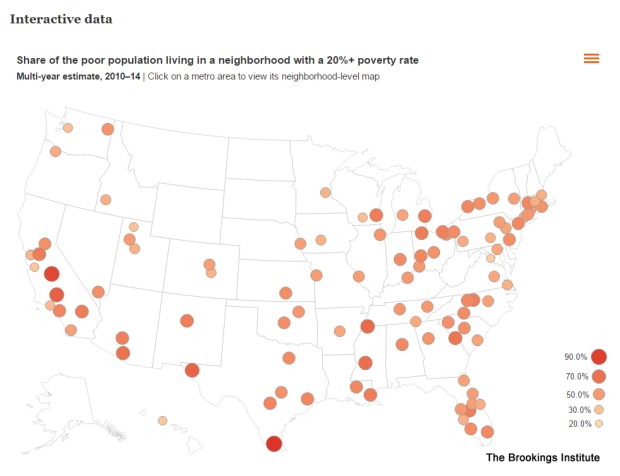
A novel development, however, makes our ‘traditional’ notion of poverty outdated at best. Today poverty in America is more concentrated in distressed areas than it was a decade ago, The Brookings Institute reports, for example in areas like the one east of Troost in Kansas City or the South Side in Chicago. More than twice as many Americans lived in extremely poor neighborhoods in 2010-2014 than in 2000. The effects of this recent concentration, given our increasingly digitized world, mount exclusion on top of poverty. It is easy to leave people in “the dark” if they are concentrated together. It is easy to leave people on the other side of the digital divide.

Brookings  map with source.jpgConcentrated poverty means not just lack of economic and social opportunities. It means lack of access to quality education, jobs, healthcare, daycare, citizenship, legal services, the political process and technological advances. It means disconnection from many resources and disengagement from active citizenship. Conversely, studies have shown that children who move to lower-poverty communities are more likely to attend college and have substantially higher incomes as adults.

The ubiquitous Internet could become the much needed uplifting tool for those in concentrated poverty areas; enabling Internet access could help to bridge the digital dive. While not a panacea to all socioeconomic challenges, Internet access does open opportunities—to communicate, gain knowledge, apply for jobs, shop, access healthcare resources and online financial services, just to name a few. Unfortunately, lack of Internet access offers none of these opportunities. Instead, to make things even worse, all the apps and online resources, which are so readily available today, build invisible fences that hold captive many Americans in disadvantaged communities. This persistent digital divide exacerbates poverty.

So why do we care? We should care because all residents, at or below the federal poverty level (e.g., $24,300 for a family of four in 2016), in these communities face socioeconomic challenges, from poor-performing schools to high crime rates, and the chances for economic mobility for those below or at the poverty level diminish every year. They are entrenched. We should care because concentrated poverty results in negative consequences for all of us, regardless of how many apps we carry on our cell or how tucked away we are in our suburbia (albeit the suburbs’ home is the largest and fastest-growing poor population).

The digital divide impoverishes the poorest and leaves all of us behind many other developed nations on the digital highway. As other countries, like South Korea and Sweden, speed in the digital era, our very own domestic lack of Internet access only exacerbates socioeconomic inequality. Internet access as a utility could be the leverage we need to enable all Americans partake in the digital revolution and the global digital community. Internet access for all benefits all.

Tri logo small